The Real Reason Players Quit at Week 2
Most games have strong D1 numbers and broken D14. The problem isn't the game -- it's that week 1 was designed and week 2 wasn't.
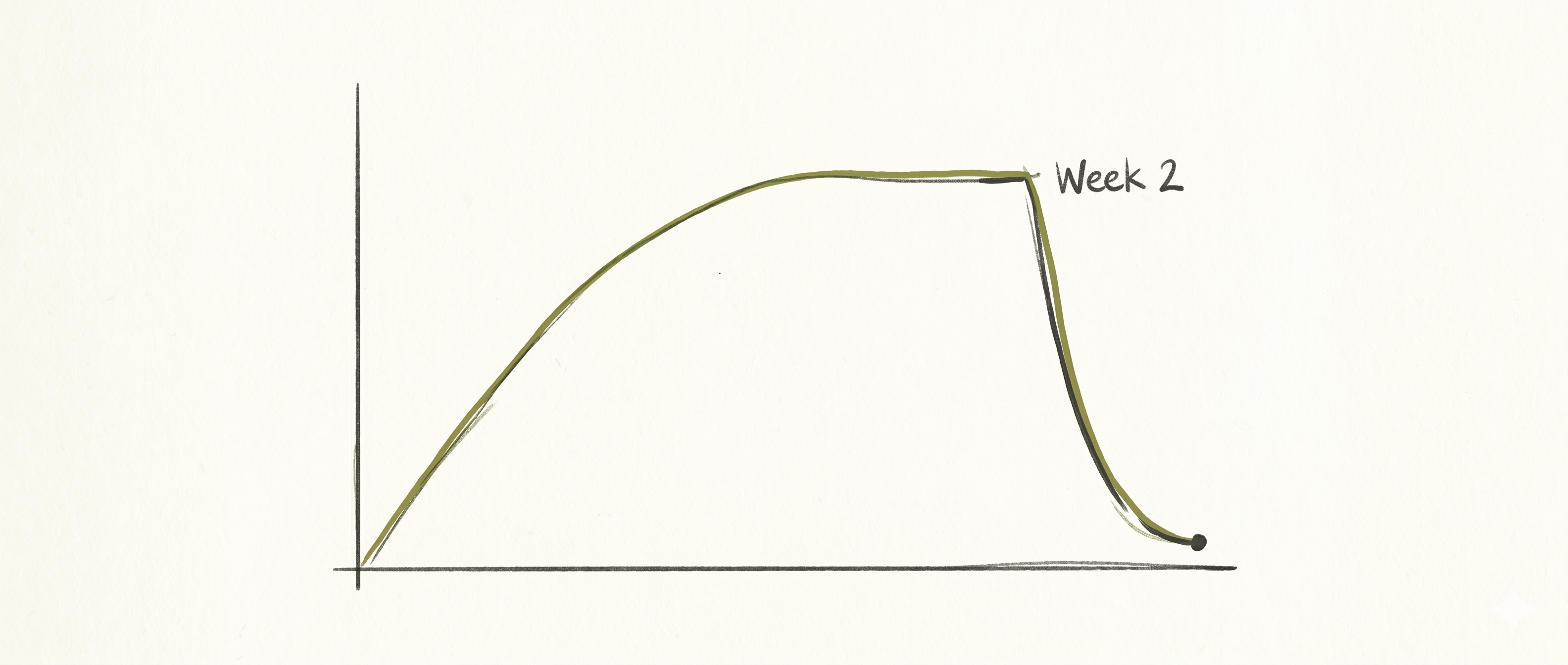
Most studios watch their D7 retention and feel good if it clears 20%. That's the wrong number to celebrate. Day 7 is still inside the onboarding bubble. The real test comes in week 2, and most games fail it quietly, without anyone understanding why.
Players don't quit at week 2 because your game is bad. They quit because your game made a promise in week 1 it couldn't keep.
Week 1 is engineered
Good onboarding is a controlled reward flood. Players earn XP faster than they ever will again. Unlocks come quickly. Every session ends with something new. The difficulty curve is flat because you're teaching mechanics, not testing them. The game is generous because it has to be. It is competing against every other app on a player's phone, and it has about 72 hours to hook someone before they forget it exists.
None of this is accidental. The mechanics doing this work are well understood: urgency from limited-time content, variable rewards from loot and drops, accomplishment from rapid leveling, loss avoidance from streaks and daily rewards. Together they create a compulsion loop that is extremely effective.
The problem is what happens when it stops.
The week 2 problem
Around day 7 to 10, reward density drops. It has to. You cannot sustain tutorial-level generosity indefinitely without breaking your economy. The daily login bonus shrinks. Levels take longer. Unlocks space out. For many players, this is the first time they experience your game as designed, not as sold.
And here is what they find: the compulsion loop was holding everything together.
When urgency, novelty, and reward density drop simultaneously, players are left with the actual game. If that game has real depth, they stay. Mastery to develop, strategies to discover, a world to invest in. If what is left is a slower version of week 1 with bigger numbers, they leave. Not dramatically. They just open the app less. Then they stop.
This is the week 2 churn pattern. The data signature is distinctive: D1 is strong, D7 is acceptable, D14 falls off a cliff. Most studios see it and reach for a fix that does not work.
False progression
The most common underlying problem is false progression: systems that create the sensation of advancement without delivering meaningful change. The XP bar fills. The level number goes up. A notification fires. But the player is not more capable. The game is not more interesting. Nothing actually changed.
False progression is invisible in week 1 because everything is new. Players do not have enough context to notice the numbers are decorative. By week 2, they have run the loop enough times to feel the emptiness underneath it. The moment they can predict exactly what the next session will look like is the moment they start to drift.
What makes this hard to diagnose from the inside is that false progression shows up in the data as normal engagement. Players are still logging in, still completing sessions. The churn signal only appears two weeks later, when the slow fade becomes an exit.
What progression actually means
Progression is not one thing. There are four distinct types, and each one serves a different player need.
Stat-gain progression gives players more power: higher numbers, stronger abilities, better gear. This is the most common type and the one week 1 runs on. Players feel it immediately.
Mastery progression gives players more skill: they understand the game better, make smarter decisions, execute more cleanly. This takes longer to develop and requires the game to have real depth to reward it.
Discovery progression gives players more knowledge: new mechanics, story beats, emergent combinations they have not seen before. It feeds curiosity and creates the sense that the game is bigger than it first appeared.
Accomplishment progression gives players closure: a goal completed, a boss defeated, a set finished. This is the satisfaction of the arc, not just the journey.
Most games over-invest in stat-gain and underbuild the other three. That creates a game that feels incredible for the first few days and hollow by day ten. Players ran out of stat-gain novelty, and there was nothing else waiting for them.
How to spot it in your own game
Map your progression curve. Chart the rate at which players gain levels, unlock content, receive meaningful rewards, and encounter new mechanics. Not just over the first session, but over the first three weeks.
Look for a second inflection point. The first is onboarding: high density, fast pace, generous rewards. The second should appear around day 7 to 10, a shift in the type of engagement, not just the rate. If your curve just gradually flattens with no shape change in that window, you are delivering a slower version of week 1. There is no second hook.
Also look at what players are actually doing in session 15 versus session 3. If the answer is the same things, just further along, you have a false progression problem. If they are making different decisions, solving harder problems, or using mechanics they did not understand at launch, that is real progression.
The fix
Adding more rewards does not solve this. More login bonuses, bigger event drops, and increased XP rates are all week 1 solutions applied to a week 2 problem. They delay the problem. They do not fix it.
The real fix is designing week 2 with the same intentionality as week 1. That means identifying the first moment of genuine mastery in your game: the session where a player first surprises themselves, first solves something that felt hard, first makes a decision that pays off in a way that was not obvious. That moment needs to arrive before day 10.
If you do not know what that moment is in your game, that is the diagnosis. You have stat-gain progression and no mastery hook. You need to build one.
What we see in practice
We have worked with studios that had D1 and D3 numbers they were proud of and D14 they could not explain. The economy looked healthy. The onboarding tested well. The game felt good. The problem was always the same: week 1 was designed, week 2 was not.
The players were not bored with the game. They were bored with a version of the game that was never meant to last. Week 2 is where the game has to stand on its own. Design it accordingly.
That's balance!