Why Your Game Economy Feels Unfair (Even When the Numbers Are Right)
Players say your economy is unfair. The spreadsheet says it isn't. Both are correct. Here's why mathematical balance and perceived fairness are two completely different problems.
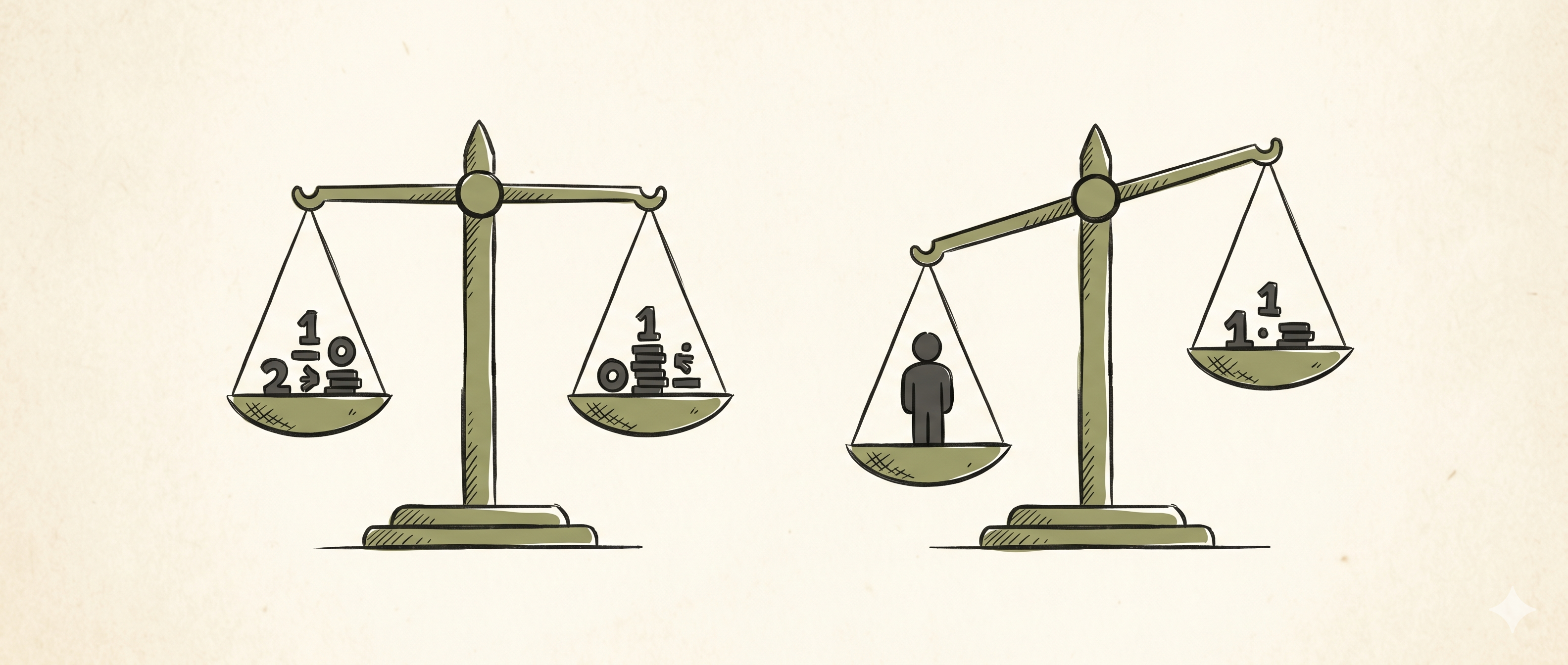
The complaint comes in the reviews, in community forums, in Discord servers: the economy feels unfair. Pay-to-win. Punishing. Rigged.
You open the spreadsheet. Sources and sinks are balanced. Drop rates are what you designed. The math is correct.
And yet the players are right.
Mathematical fairness and perceived fairness are not the same thing. They never were. Designing an economy that actually feels fair requires understanding both, and most studios only design for one.
Two different problems
There are at least seven distinct kinds of balance in a game: mathematical balance, difficulty balance, progression balance, and balance as fairness among them. The fact that these need to be listed separately tells you something important. A game can be mathematically sound and still feel deeply unjust to the player experiencing it. These are different problems with different solutions.
Most economy designers are trained to solve the mathematical one. The spreadsheet is the tool, numbers are the output, and when the numbers work, the job feels done. The perceived fairness problem is harder because it lives inside the player's head, not the spreadsheet.
The reference point problem
Players do not evaluate your economy in absolute terms. They evaluate it relative to something: what they expected, what they got last time, what they see other players getting, what the game implied was possible.
This means the same drop rate can feel generous or exploitative depending entirely on context. A 2% legendary drop rate feels fair in a game where legendaries are explained as rare. It feels criminal in a game where the onboarding showed you using one. The number is the same. The experience is completely different.
Anchoring is the cognitive bias at work here. People attach to a reference number early and judge everything relative to it. If your onboarding sets expectations the mid-game cannot meet, the economy will feel like it degraded, even if nothing changed. The player's anchor shifted, not your numbers.
The Gambler's Fallacy and loot design
Human probability intuition is systematically wrong in ways that directly affect how players experience your economy.
The Gambler's Fallacy is the belief that a string of bad outcomes makes a good outcome more likely. It does not. Each drop is independent. A player who has opened fifty chests without a rare item does not have better odds on the fifty-first. But they feel like they do, and when the fifty-first chest is also empty, the economy feels broken. Cheating them. The math is working exactly as designed. The player's experience of it is not.
The Hot-Hand Fallacy runs in the opposite direction: the belief that a string of good outcomes continues. Players on winning streaks feel invincible and make riskier decisions. When the streak ends, the loss hits harder than the equivalent gain felt good.
Neither of these is the player being irrational. These are predictable, universal patterns in human cognition. Designing an economy without accounting for them is designing for a player that does not exist.
The transparency gap
One of the most consistent sources of perceived unfairness is not the system itself but the player's inability to understand it. When players cannot model how your economy works, they fill the gap with suspicion.
Drop rates that are not disclosed feel manipulated, even when they are fair. Resource sinks that are not explained feel punishing. Mechanics that work against players without clear signaling feel adversarial.
Transparency is not just an ethics consideration. It is a design tool. Players who understand why they are losing feel challenged. Players who do not understand why they are losing feel cheated. The underlying experience can be identical. The perception is completely different.
Fairness is a communication problem
The fix is not always changing the numbers. Often it is changing how the system communicates itself.
Show drop rates. Explain why resources cost what they do. Signal what the player is working toward and how far away it is. Give players enough information to model the system in their head, even approximately.
When players feel informed, they feel respected. When they feel respected, the same economy that generated complaints starts generating trust. Nothing in the spreadsheet changed. The player's relationship to the system did.
That said: transparency cannot fix a system that is genuinely extractive. If the math is designed to obscure real costs, visibility will make it worse. Transparency only works on top of actual fairness, not instead of it.
What this means in practice
When players call your economy unfair, the instinct is to defend the math. Resist it. Instead ask: what anchor did we set in onboarding that the mid-game violates? Where are players filling information gaps with suspicion? What cognitive biases are our drop rates colliding with?
The numbers are the starting point, not the ending point. An economy that is fair and that players experience as fair requires both the math and the design around it.
One without the other is not good enough.
That's balance!